
Notes that translate the heart’s breathing between feeling and language.
Chapter 3: The Blind Spot of Self-Awareness
— The Structure Behind “Those Who Cannot See Their Outside”
I. The Paradox of Self-Awareness
In Chapter 3 of the main text, I wrote: “Clear within, blind without.”
This is the paradox of self-awareness in psychology.
Two Selves
Psychologist William James divided the self into two:
The Self as Subject (I):
- The self that experiences
- The self that feels
- The self seen from within
The Self as Object (Me):
- The self that is observed
- The self that is evaluated
- The self seen from without
Introverted people see “I” with clarity, but “Me” remains invisible.
Because they always remain in the perspective of “I.”
Asymmetry of Metacognition
Metacognition is the ability to recognize one’s own thoughts and emotions.
Introverted people excel at internal metacognition. “Right now, I’m feeling anxious.” “Right now, I’m overthinking.”
But they struggle with external metacognition. “Right now, how am I being perceived?” “Right now, what does my expression look like?”
This is what I call the asymmetry of metacognition— clear within, but blind without.
II. The Johari Window
To understand self-awareness, there’s a model called the Johari Window.
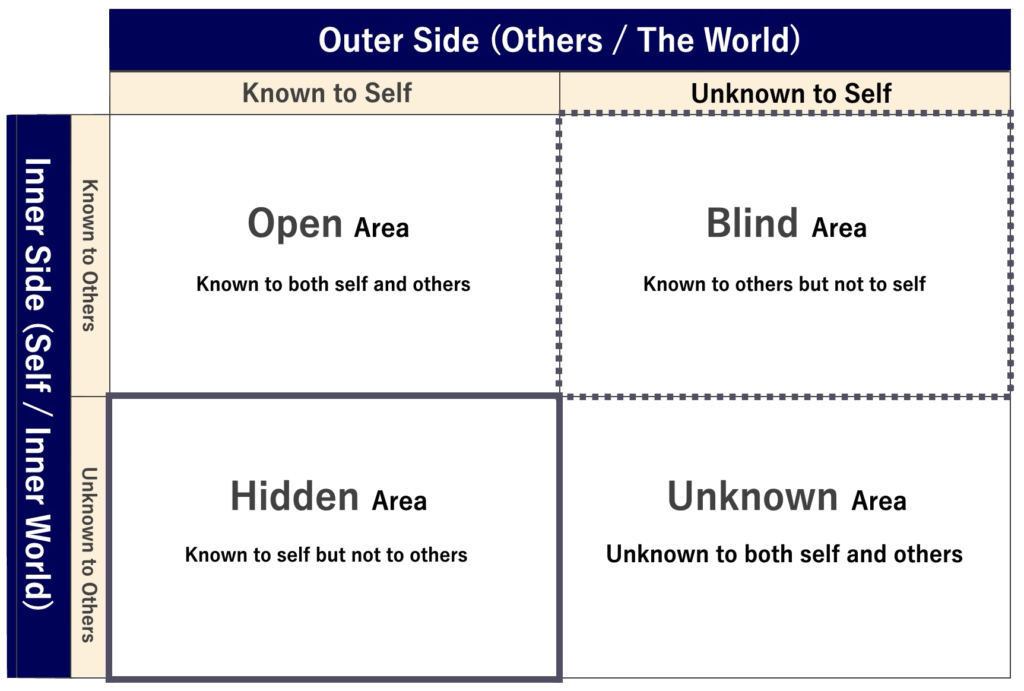
The Blind Window
The blind window: The part visible to others, but invisible to oneself.
For introverted people, this blind spot is large.
For example—
- The tone of one’s own voice
- One’s own facial expressions
- One’s own presence
- One’s own influence
Visible to others, but invisible to oneself.
The Hidden Window
The hidden window: The part one knows about oneself, but doesn’t show to others.
For introverted people, this hidden part is also large.
A rich inner world. Deep thinking. Delicate emotions.
These are not put outside.
So they’re told, “I can’t tell what you’re thinking.”
III. The Structure of Being Unable to Speak Before Crowds
In the main text, I wrote about the difficulty of speaking before crowds. Here, we’ll look at the neuroscience behind it.
Overload of Multiple Inputs
Standing before a crowd, the brain must process enormous amounts of information.
Visual information:
- Audience expressions
- Movement of gazes
- Changes in posture
Auditory information:
- Murmuring
- Coughs
- Sounds of chairs
Sensory information:
- Brightness of lighting
- Temperature
- Flow of air
Social information:
- Expectations
- Evaluations
- Reactions
Extroverted people can filter these as “noise.”
But introverted and HSP individuals pick up everything.
As a result, the brain becomes overloaded.
Strain on Working Memory
When speaking before crowds, working memory is required.
Working memory is the ability to hold and process information short-term.
What’s needed when speaking:
- What to say (content)
- How to say it (expression)
- Observing others’ reactions (observation)
- Managing time (control)
All of these must be processed simultaneously.
But for introverted people, with the “multiple inputs” mentioned above, working memory is already under strain.
So the content they meant to say flies away.
Detection of Social Threat
Furthermore, the brain is detecting social threat.
The amygdala responds not only to physical threats, but also to social threats.
Social threats:
- Being rejected
- Being evaluated
- Being laughed at
- Being misunderstood
Before crowds, these social threats are amplified.
So the amygdala becomes hyperactive, and anxiety increases.
The Spotlight Effect
In psychology, there’s a phenomenon called the spotlight effect.
People think “others aren’t watching me as much as I think they are,” but feel “everyone is watching me.”
For introverted people, this spotlight effect is strong.
In reality, most of the audience isn’t paying that much attention.
But they feel “everyone is evaluating me.”
That amplifies the tension.
IV. Why One-on-One Conversation Works
In the main text, I wrote: “Can speak deeply one-on-one, yet suddenly unable to speak before many.”
Let’s look at this structure.
A Single Wave
In one-on-one situations, the other person’s wave is singular.
- Expression: one
- Reaction: one
- Emotion: one
So it’s easier to match that wave.
Introverted people excel at this “fine-tuning.”
Choosing words while observing the other’s level of understanding. Adjusting tone while sensing the other’s reaction.
This is an introverted strength.
Confusion of Multiple Waves
But before crowds, there are multiple waves.
- People who are interested
- People who are bored
- People who are viewing critically
- People who are empathizing
All these waves crash in simultaneously.
And they can’t figure out which wave to match.
Responding to all is impossible.
But introverted people sense all of them.
As a result, they lose their own wave.
Safe Distance
In one-on-one settings, it’s easier to find a safe psychological distance— not too close, not too far, a space where dialogue can breathe.
But before crowds, distance control is difficult.
Some people are too close, others too far.
That unevenness of distance creates anxiety.
V. Why Writing Works
In the main text, I wrote: “Can convey through writing, but cannot convey face-to-face.”
Let’s look at the reasons.
Asynchronous Communication
Writing is asynchronous communication.
Time can be taken to choose words. No need to feel others’ reactions immediately.
Introverted people need this “temporal margin.”
Time to translate what’s felt into words.
Blocking Visual Information
In writing, the other person’s expression isn’t visible.
At first glance, this seems like a disadvantage.
But for introverted people, it’s an advantage.
Because they’re not overwhelmed by visual information.
Others’ expressions, gazes, postures— no need to process all of these.
So they can concentrate on their own words.
Possibility of Revision
Writing can be revised.
After writing once, it can be read back and corrected.
This “freedom to redo” creates a sense of security.
Face-to-face, words once spoken cannot be taken back.
But with writing, it can be perfected before sending.
VI. Fragile Trust in Others
In the main text, I made the most important observation: “Not self-esteem, but trust toward others.”
Here, we’ll look at the psychology behind this.
Attachment Theory
Psychologist John Bowlby proposed attachment theory.
Early childhood relationships with caregivers influence subsequent human relationships.
Secure attachment:
- Caregiver is stable
- Needs are met
- Learns the world is safe
Insecure attachment:
- Caregiver is unstable
- Needs are not met
- Learns the world is dangerous
Internal Working Model
Attachment patterns form an internal working model.
This is an unconscious belief about “Are others trustworthy?” “Am I valuable?”
People with insecure attachment have an internal working model that says “Others cannot be trusted.”
So when speaking before crowds, they unconsciously feel “I might be misunderstood.” “I might be criticized.”
This isn’t a problem of self-esteem. It’s a problem of trust toward others.
Foundation of Social Trust
Social psychologist Erik Erikson placed basic trust at the first developmental stage.
In the first year of life, through relationships with caregivers, the sense that “the world is trustworthy” is nurtured.
Without this basic trust, constant anxiety is felt in subsequent social relationships.
That introverted people cannot speak before crowds isn’t a problem of ability— it’s possible that the foundation of trust hasn’t been nurtured.
VII. Bridge to the Main Text
Chapter 3 of the main text spoke poetically: “Those who cannot see their outside.”
This commentary unpacked that structure.
Summary of Structure
1. Asymmetry of Self-Awareness
- Subjective self (I) is clear
- Objective self (Me) is invisible
- The blind window is large
2. Overload Before Crowds
- Processing multiple inputs
- Strain on working memory
- Detection of social threat
3. Advantage of One-on-One
- Single wave
- Control of psychological distance
- Skill in fine-tuning
4. Advantages of Writing
- Asynchronous communication
- Blocking visual information
- Possibility of revision
5. Fragile Trust in Others
- Attachment theory
- Internal working model
- Lack of basic trust
Dialogue with the Main Text
The main text spoke to you: “That you cannot speak before crowds isn’t because you’re weak— it’s because you feel the world with delicacy.”
This commentary explained the reasons.
Your brain is processing enormous amounts of information. I proved this in the language of neuroscience.
And “lacking confidence” isn’t the issue— “you simply haven’t yet found a place you can trust.”
I supported this perspective with attachment theory.
Inhale deeply, exhale slowly. Within that quiet rhythm, let trust begin to grow.





コメント